I like to diversify my perspective, so I picked up this book to explore “the other side” of Saudi life. I realised that in my attempt to discover Saudi Arabia through books, I had unwittingly mostly read books on stories of Saudi nationals. I had of course read books on Saudi Arabia by authors from different countries, but the stories they told were (mostly) of life from a Saudi perspective. Perhaps this is an effect of my own experiences—as a non-resident alien living in a foreign country, it is hard to come across works by non-nationals that truly take the time to understand and relay the experiences of people from another society without particular pre-oriented leanings.
And perhaps foreigners should not be expected to tell the stories of others without bias—as people, our stories surely will be coloured by our perspective—which is certainly not a terrible thing. Still, I have discovered that because so little is known of regions like “the Middle East” and “Africa,” books from the perspectives of foreigners easily become the authority on the lives of others, and to take only that account as a reader will simply not give me a fair exploration or understanding of regions that do not have the global ‘airtime’ or platform that many Western countries do.
In any case, this book gave me an opportunity to look into this idea of mine that the perspective of non-nationals may be ill-equipped to tell relay balanced stories of unfamiliar regions, and to brush up on my understanding of Saudi society, which I had initially delved into five years ago…
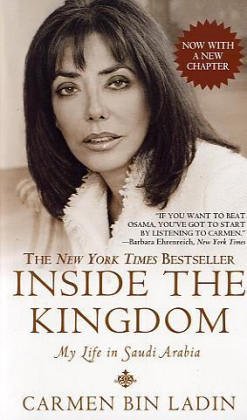
The Rundown
Country: USA;
on Saudi
Arabia, 2004
Author:
Carmen bin Laden
Genre: Memoir, Non-Fiction,
Autobiography,
Languages:
English
Publisher: Grand
Central Publishing
Pages: 224
Love it or Hate it? Read
it… with a grain of salt
Synopsis in A Sentence: The wife of one of
the brothers of Osama bin Laden tells of her experiences from Switzerland and
Iran, through courtship in the U.S. and marriage into the Saudi Arabian clan of
the bin Ladens.
Think: Princess: A True Story of Life Behind the Veil in
Saudi Arabia.
Mob wives in Saudi
Arabia, with a lot less intrigue, and a bit more political analysis
The Good: For what it is,
Inside the Kingdom offers a very insightful
story, taking us through the layers of veiled mystery that is Saudi Arabia.
Most of us will never get the chance to experience the hidden kingdom, so this
book is indeed one of the few resources that gives us valuable historical
context and insight into the daily lives of true Saudi elite.
The author’s
experience is invaluable in that she experienced transformations through Saudi
history that have rarely been penned down in this way—from the viewpoint of a
personal account. From Carmen bin Laden’s story we experience the changes
through Saudi society, from the ‘70s through the ‘90s. So we learn of the
initial construction of the country after the oil boom, the first buildings of
supermarkets and malls and the relative freedoms that existed in Saudi life. We
learn how global events like the Siege of Mecca, the Iranian Cultural
Revolution and the Soviet invasion of Afghanistan impact Saudi society and the
lives of men and women in the country. For this insight, this book is valuable
and appreciated.
The prose is clear
and well written, with small anecdotes unravelling the personal story of one
bin Laden family and the elites they roll with. The book very clearly takes a
stand on the state of Saudi Arabia, its people, the impact on religion on the
country, and an analytical outlook into the role of the country future global
politics, all from the author’s perspective. And while I value the book for
this unique perspective, I also take the ideas it espouses with a fair grain of
salt…
…because I
have read more. I try never take one book for what it says on a subject—I try explore varying viewpoints especially viewpoints challenging my own: read fiction, non-fiction,
historical accounts, political and socio economic analyses, and then use that
insight to discern what a society may really be really like.
The Bad: There is a fundamental problem with seeing one culture
from another cultural lens, yet remaining unaware of our own coloured cultural
lenses and experiences. So how may we be able to put aside our lenses, and how
do we truly try to take a balanced view on ideas we may have not previously
known, may not understand, and possibly may not even be interested in?
This book does
what I decry the most in books— it looks at experiences from an alien
perspective, not even attempting to truly take a look at what it may be like to
be born into that society. Every society has a unique outlook, and honestly,
every society thinks that they have it best—until their experiences are
challenged by a way so different it is perplexing, uncomfortable and may
eventually even become threatening.
In this book, we
look at Saudi Arabia from a foreigner’s perspective—A woman who identifies as Western—A woman who was never particularly interested in understanding the
society she went on to live in and become a part of. And there is a distinct
difference between deliberately seeking to live in and take part in a society,
and marrying a man from that society for the sake of love.
This book may be
enlightening to a novice explorer of Middle Eastern societies when it comes to
issues of women’s life in Islamic countries and the absoluteness of family. It
will also certainly be enlightening to women who think they can get married to
a man without marrying his family. It will be educational to those who might
have not considered the legal complexities involved in an international
marriage and the impact that national laws have on the lives of families. But
if these essentials were already known, then this book will be one of those
that goes on about the restrictiveness of Islam and the oppression of women and
the “backwardness” of Saudi culture. And these are not my words. It is clear
through the story that the author had not quite considered the implications of
the decisions she made when she married a Saudi man, let alone a bin Laden—one of
the most elite and influential families in the world.
While being of Iranian and Swiss decent, Carmen bin Laden’s perspective is particularly Western, which is certainly not a negative thing. There is however an issue when there is such a patronizing regard—when a person thinks that she can be the answer to a society— When a person in-fact thinks that her little daily actions can, in her words, “modernize” the society. From the accounts in her book, and as a foreigner living in another country, Carmen bin Laden seemingly did not attempt to take Saudi Arabia for what it was, but would rather have Arabia become Western. Even as a foreigner living in another country, I cannot help but think of this as condescending and even bearing undertones of colonial-like thinking.
In all fairness,
the author herself seems to have experienced a fair amount of condescision in
her life, particularly in Saudi Arabia. Yet the notion that by hosting tennis
parties in her villa she could show Saudi men the importance of engaging with
their wives as equals, and hence help transform—even modernize—the country is
deeply, deeply misguided.
The Verdict: The stories and experiences and insight that Carmen
bin Laden’s book brings to the world is valuable. It is better that the stories
be told than not. At the same time, especially for readers not yet exposed to
books on the Middle East, to take this entire book completely, without
considering its leanings and the particular perspective that it portrays would
only mystify insight into an already mystified country.
It is certain that
the Middle East has challenges, like every region of the world. To more
effectively gain insight into Saudi and Muslim societies in the English
language, I would highly recommend books by Rajaa Alsanea, Ameera Al Hakawati, and Jean Sasson, written by Saudi, British, and
American authors with less tinted viewpoints on the region. Their books
highlight the challenges of the region without sugar coating them, yet they
take the time to do what effective books should—deliver understanding on a
subject (or two) J
3/5 Stars
Memorable
Quotes:
1.
“One of the students in my English class was a
Saudi named Abdel latif. He was dumb struck when he heard I was engaged to Yeslem
bin Laden. He came up to me very formally to say that he had known Yeslam’s
father, who had died in 1967. On the other side of the world, Abdel latif was
the first person to open my eyes to the body of Saudi legends surrounding
Sheikh Mohammed bin Laden…
2.
”One March morning in 1975, Yeslam woke me with
the news that King Faisal had been assassinated—shot by one of his nephews. I
could feel his sense of panic and urgency. Saudi Arabia was in an uproar, Yeslam
told me. It was claimed that the assassinator was deranged but it was most
likely a revenge killing, Yeslam said. The murderer’s brother had been executed
10 years previously for participating in an Islamic fundamentalist revolt
against the king’s decision to authorize television in the kingdom.”
3.
“Still, try as I might, I never could manage to
teach my daughters to practice the manipulative, underhanded behaviour that
characterized the women around me. Perhaps for the children’s’ good, I should
have made that effort, but I felt powerless to prepare them for lives as Saudi
women. I hated even thinking about it.”







 Posts
Posts


